Every UTV track system is the same idea in a different shape: a rubber belt riding on rollers, driven by a sprocket that bolts where your wheel used to. The differences between systems — and what they're good at — come down to how the rubber, the rollers, and the install kit are designed.
Track system anatomy
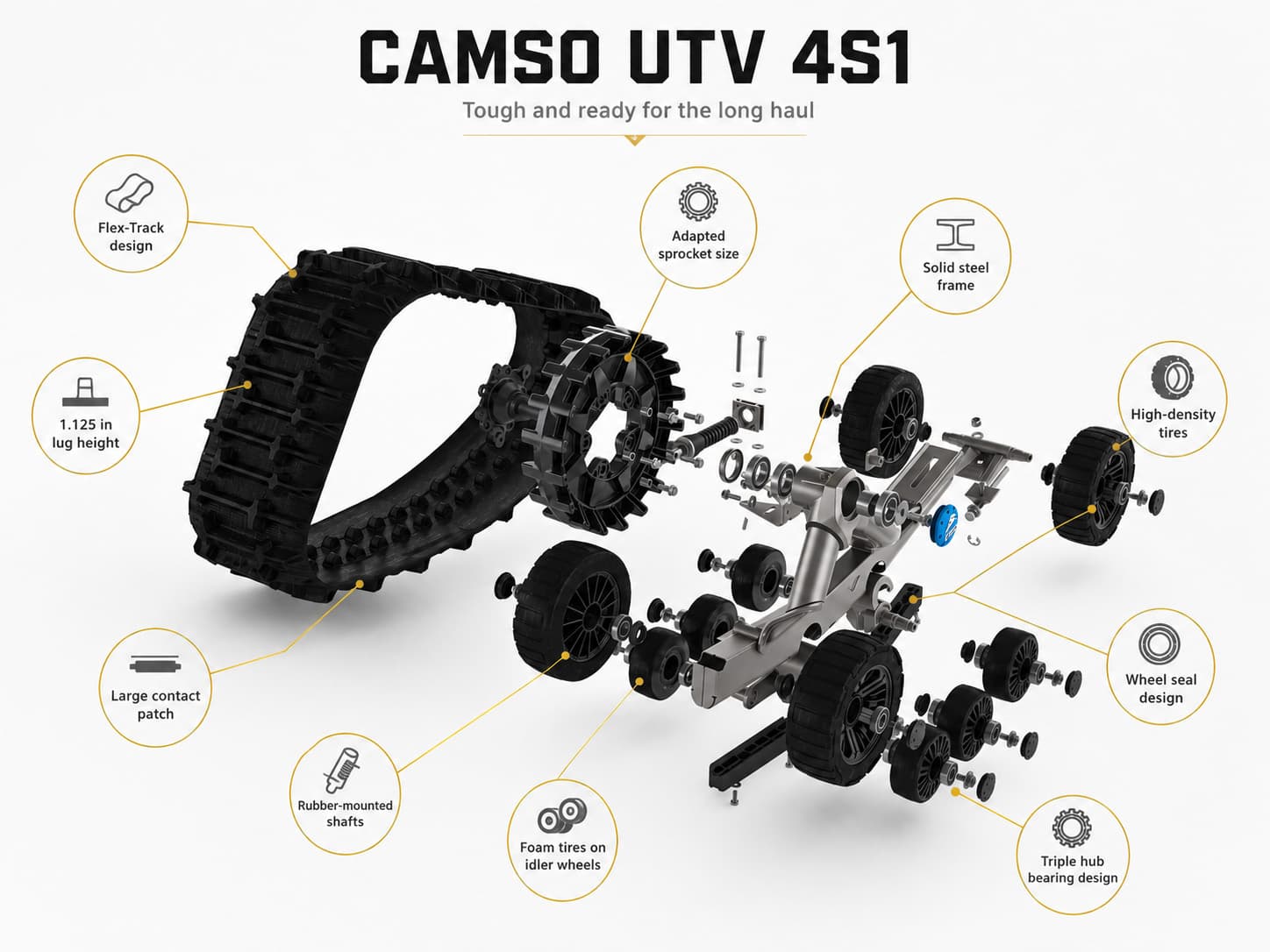
Each of the four tracks on a UTV is made up of the same parts. Once you understand one, you understand all of them.
The track (rubber belt)
The rubber belt — what most people call “the track” — is a long, reinforced loop of rubber with internal cables or fabric for strength, molded drive lugs on the inside that engage the sprocket, and tread chevrons or paddles on the outside that grip the ground. Track pitch (lug spacing) and pattern (chevron aggressiveness) are tuned to the intended use — soft snow versus mixed work, for example.
The drive sprocket
The sprocket bolts to the hub (where your wheel was) and engages the inside lugs of the track. When the hub turns, the sprocket turns, and the track rotates around the unit. Drive sprocket diameter and tooth count are part of how the system's effective gearing is set.
Idlers and rails
The track also rides over a set of idler wheels (front, rear, top) on a steel railframe. The idlers manage tension and guide the track around the unit; the rails carry the load to the ground. The frame includes pivot points that let the whole assembly “walk over” uneven terrain — which is why a track unit can roll over a log a tire would catch on.
Slide guides (or wheel guides)
Most systems use plastic slide guides on the rails to let the track move smoothly with minimal friction in low-snow or dry conditions. These are consumables. Most owners replace them every few seasons depending on use.
One brand — Soucy's HD4Pro — takes a different engineering approach and uses internal wheels to guide the track instead of plastic slides. The benefit: no slide-guide replacement cycle. The tradeoff: a more specialized, single-vendor design. Both approaches work; the choice depends on how you weight maintenance simplicity against parts ecosystem.
The install kit
The unsung hero of every track installation. The install kit (also called the mounting kit or bracket kit) is the set of vehicle-specific brackets that anchor the four track units to your UTV and prevent them from rotating freely around the hub. Without the kit, the entire track unit would just spin in place.
Install kits are specific to the year, model, and generationof your machine. A bracket designed for a 2020 Ranger XP 1000 will not fit a 2018 Ranger XP 1000, even though the machines look identical. This is the single most common fitment mistake we see — buyers assume “Polaris Ranger” is enough, when the kit revision matters as much as the nameplate.
Ground pressure: the actual physics
The reason tracks work isn't magic — it's contact patch. A UTV tire might have a ground contact patch of 30–50 square inches per wheel, total. Spread the same machine weight across four track units and you might be looking at 500–800 square inches of contact. That's an order of magnitude more surface area carrying the same weight.
The result: a UTV on tires runs roughly 8–10 psi of average ground pressure. The same UTV on tracks runs closer to 0.5–1.0 psi. Snow can support 0.5 psi. It can't support 10. That's why one floats and the other sinks.
Steering & geometry changes
Replacing wheels with tracks changes more than traction. A few things shift the moment the unit bolts on:
- Ride height typically increases 2–4 inches.Track unit geometry sits taller than the original tire's rolling radius. Headlights point higher, bumpers sit higher, and the driveline runs at a slightly different angle.
- Steering effort goes up. Tracks have more contact patch and more rolling resistance than tires. At low speed and full lock, you feel it. EPS helps; non-EPS machines feel it more.
- Effective gearing changes.A larger rolling-equivalent diameter and more drag means the machine behaves like it's in a taller gear. This is why some installs benefit from a gear reduction kit.
- Turning radius widens slightly. The track unit pivots around its own center, not the wheel center, so very tight turns feel different — especially in confined spaces.
Effect on powertrain
Tracks add load to everything between the engine and the ground. The components most commonly affected:
- CVT (belt drive). Heavier loads at lower speeds mean the belt spends more time slipping during engagement. Belt wear can accelerate. Vented CVT covers help.
- Axles and CV joints. More rolling drag and the slightly increased lever arm of the track unit add load to axles. Severely abused machines can shear them; normal use rarely does.
- Bearings. Hub bearings see new side loads. A quality install kit minimizes this, but bearings will run hotter in track use than in tire use.
- Brakes. Stopping a heavier, gripper machine in slick conditions asks more of the brakes. Most owners notice no problem; some platforms benefit from upgraded pads.
Common system types
You'll see the same general anatomy across all UTV tracks, but there are meaningful design differences between the common systems. At a high level:
Heavy-duty / work UTV tracks
Designed for sustained work, year-round use, and 1000cc+ utility UTVs. Examples include the new Camso UTV ENDUR, Kimpex Commander HD4, and Soucy HD4Pro. The serious choice for working operators.
Standard four-season UTV tracks
The most common buy for full-size UTV recreational and light-work users. The Camso UTV 4S1 is the dominant option. Versatile across snow, mud, and packed trail without paying heavy-duty money.
Wide-stance / soft-snow specialist tracks
Wider footprint, shorter lug pitch, optimized for deep snow and soft ground. The Kimpex Commander WSS4 is the best-known example.
ATV / small-UTV crossover tracks
Designed to fit both ATVs (300–1000cc) and smaller UTVs (400–700cc). The Camso X4Sis the dominant example. Don't confuse this with a heavy-duty UTV track — it isn't one.
OEM tracks
First-party tracks from UTV manufacturers. Polaris's Prospector Pro 2.0 is the main current example. Worth considering for Polaris owners who value dealer-integrated install and warranty alignment.
Sport tracks
A small category — track systems designed for sport UTVs (RZR, X3, KRX) where suspension travel and weight are different from utility machines. These are niche but real.
Key Takeaways
- Every track system is the same idea: rubber belt on rollers driven by a sprocket at the hub.
- The install kit is the vehicle-specific bracketry that prevents the unit from rotating freely — this is the most fitment-sensitive part.
- Tracks reduce ground pressure 10x or more — that's why they float on snow and mud.
- Ride height, steering effort, and effective gearing all change once tracks are installed.
- CVT, axles, bearings, and brakes all see new loads; routine maintenance is what makes that survivable.