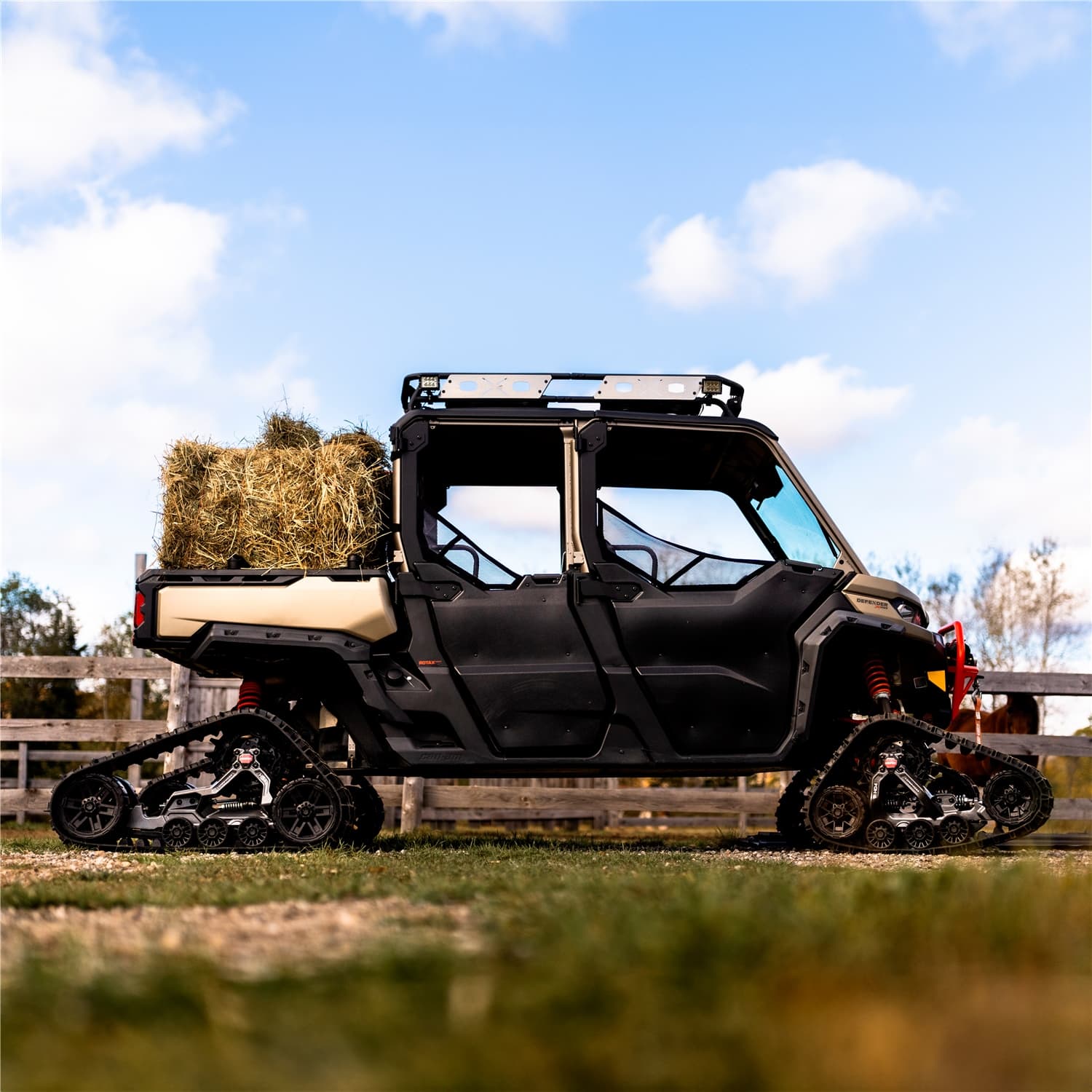
If you only ever use tracks for one purpose, it should be snow. The combination of flotation, traction, and predictable winter access is what tracks were designed to deliver — and most of the regret stories about tracks come from owners who bought them for something else.
Why snow is the killer use case
Two things matter for moving through snow: the ground pressure of the machine, and the lug pattern of whatever is in contact with the snow. Tires struggle with both. The contact patch is small enough that a UTV tire eventually digs straight down rather than moving forward. Tracks invert that — large contact patch, low ground pressure, and aggressive lugs designed to grip soft surfaces.
The result: a tracked UTV that floats over snow a tired UTV would have buried itself in. For owners dealing with real winter on a regular schedule, this is the use case that justifies the spend.
Snow types & depth
Not all snow behaves the same. The two variables that matter for tracks are depth and density.
Powder (fresh, low-density)
The easiest case for tracks. Fresh snow has little structural integrity, but the low density means it doesn't resist movement much. A reasonably-sized track system handles 18–24 inches of powder without drama. Beyond that, expect the lower bumper to start plowing snow — manageable, but you'll feel it.
Settled / wind-packed snow
Compacted snow is mechanically easier — there's real support under the track — but the lug pattern needs to bite to make forward progress. Aggressive tread patterns matter more here. Most four-season tracks handle this well.
Heavy / wet snow
The hardest type. Wet snow is dense and grabby — it sticks to the tracks, the rails, the slide guides, and the underside of the machine. Mass accumulates and starts to drag. Tracks still work, but the machine works harder, the CVT runs hotter, and you'll want to stop and clear buildup every so often.
Crusted snow (ice over powder)
Variable terrain — you're alternately floating on the crust and breaking through it. Best handled at moderate, steady speed. Sudden inputs can break the crust unevenly and unsettle the machine.
Tracks + plow: the killer combo
For owners with a meaningful winter driveway or property access route, the combination of a tracked UTV and a plow is genuinely transformational. The reason: the same flotation that lets the machine reach the plow location is what keeps it from getting stuck while plowing. With tires plus a plow, you're always one drift away from being stuck. With tracks plus a plow, that risk drops dramatically.
A few considerations:
- Confirm plow mount clearance against the track system. Most mounts work, but tall installs can interfere.
- A V-plow handles deep snow better than a straight blade in high-volume cases.
- Add ballast in the bed for plow weight. Tracks distribute weight well, but you still want the rear engaged.
- Drive deliberately. Plowing on tracks lets you push harder than tires — easy to overdrive into a snowbank you can't back out of.
Right machine for snow tracks
The sweet spot for snow tracks is a full-size utility 4x4 in the 800–1000cc class:
- Polaris Ranger XP 1000, Ranger XP Kinetic — most common platform, broadest fitment support.
- Can-Am Defender HD10 — heavy, torquey, and handles tracks well. Especially good in deep snow.
- Honda Pioneer 1000 / 1000-5 — DCT transmission handles tracks more predictably than CVT in heavy snow.
- Yamaha Wolverine RMAX / RMAX4 — quieter player in the segment, but a strong reliable fit.
- Kawasaki Mule Pro — slower, but built for the work; pairs well with snow tracks for ranch and cabin use.
Mid-size machines (500–700cc) can run snow tracks, but expect to work the drivetrain harder and accept slower top speeds.
Choosing a snow-focused system
For snow, the trade-off matrix simplifies to:
- Snow-leaning four-season tracks (e.g., Camso 4S1) — strong for snow, capable in shoulder seasons, generally more affordable.
- Premium four-season tracks (e.g., Camso X4S, Kimpex WSS4) — durable, capable in everything from powder to packed trail. The default for serious users.
- Dedicated snow / wide-stance tracks — maximum flotation in deep powder, less suited to warmer-season use. A specialty choice for owners genuinely in snow most of the year.
See our snow track decision guide for the framework on choosing between these.
Common snow track mistakes
- Driving too fast. Snow tracks reward steady inputs at moderate speed. Sport-driving them is hard on belts, bearings, and your spine.
- Skipping pre-season inspection. The first deep snow of the year is the worst time to discover a worn slide guide. Pre-season check is non-negotiable.
- Plowing too aggressively.Tracks let you push into snow you can't back out of. Plow forward, retreat, re-plow. Don't bury the front bumper.
- Ignoring drivetrain heat. Heavy wet snow days put the CVT under real load. Stop periodically, check belt temperature, give it air.
Key Takeaways
- Snow is the use case tracks were designed for — it's the easiest 'yes' on the buying decision.
- Powder is the easiest snow; wet/heavy is the hardest. Plan for the hardest you'll face.
- Tracks + plow on a utility UTV is a transformational winter setup for rural users.
- Full-size utility 4x4s in the 800–1000cc class are the sweet spot for snow tracks.
- Most snow buyers should choose a premium four-season system; dedicated snow tracks are a specialty.