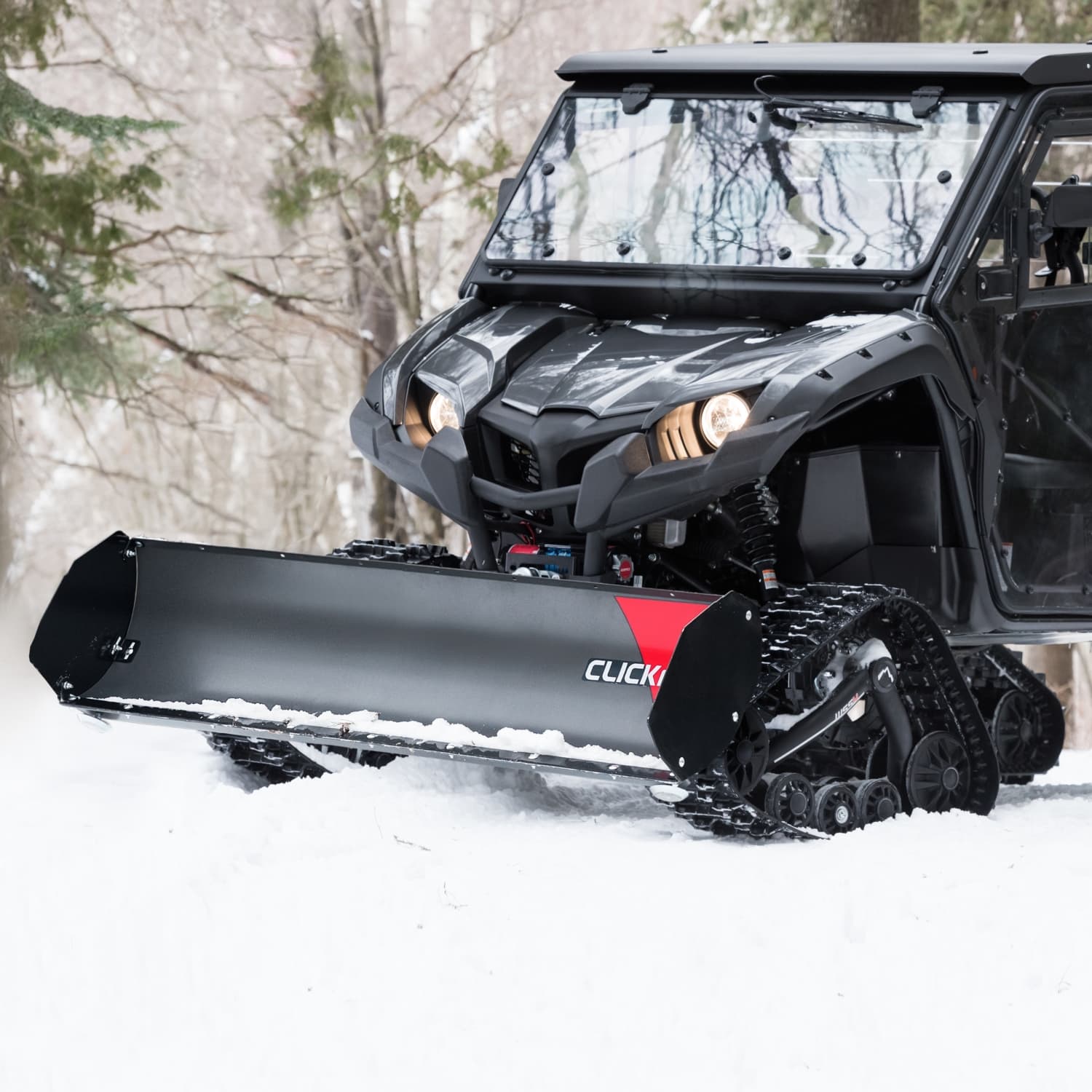
A UTV track system is a $4,500–$7,000 purchase, plus install, plus a steady drip of consumables over the next several seasons. That's real money. The right question isn't whether tracks are “good” — they're excellent at what they do — but whether what they do solves a problem you actually have, often enough, to justify the spend.
The short answer
Tracks are worth it if you need to get a UTV to places, on a regular schedule, where tires (with or without chains) genuinely can't go. That's a smaller group than the marketing implies. Common cases where tracks earn their cost:
- Snow access from October to April in regions with real winter — plowing a long driveway, working a ranch, or accessing a cabin or hunting property.
- Soft-ground work where flotation matters more than speed — saturated pasture, peat, organic soils, sandy washes after rain.
- Hunting and backcountry access in shoulder seasons and winter where you need to reach a stand, camp, or wall tent without making ruts the landowner will hate you for.
- Ice fishing where you cross slush, shoreline transitions, or variable ice on a regular basis.
- Remote property maintenancewhen the truck won't make it and the work can't wait for spring.
If you're reading that list and recognizing your week — tracks are likely worth it. If you're reading it and thinking “maybe a few times a year” — they probably aren't.
Where tracks shine
Flotation, not just traction
The thing tires can't replicate is ground pressure. A UTV on 27" tires might sit at 8–10 psi of average ground pressure. The same machine on tracks drops to roughly 0.5–1.0 psi. That's a 10x reduction in how much you're compressing the ground beneath you. Snow, mud, peat, and saturated pasture all behave differently at that contact patch — tracks float, tires dig.
Predictable winter performance
A tracked UTV makes winter use case math much simpler. You stop asking “will the truck make it” or “do I need to chain up” and start asking “is the machine fueled.” For people who actually need to move year-round — ranches, working cabins, ice fishing operations — that predictability is most of the value.
Plow + tracks is genuinely transformational
A UTV with a plow and tires is a fair-weather plowing tool. A UTV with tracks and a plow is a serious snow machine for residential and rural use. Many tracked-UTV buyers tell us this combination was the tipping point.
Where tracks struggle
Speed and ride
Tracks top out around 25–40 mph depending on the system and the machine, and they're mechanically happiest in the 10–25 mph range. The ride is rougher than tires on hard ground — there's more vibration, more headtoss, and slow-speed steering takes more effort.
Hard, dry ground
On hard-pack trails, gravel roads, and dry summer terrain, tracks are slower than tires, harder on the machine, and harder on the tracks themselves. If most of your use is hard summer trail, you're paying tracks money to be worse than tires.
Pavement is awful for tracks
Brief pavement crossings are fine. Sustained pavement driving wears rubber compounds quickly and adds heat to bearings and drivetrain. If your commute to the work site is paved, that math gets worse fast.
The break-even math
The simplest way to evaluate this is days of use that genuinely require tracks. Not days where tracks would be “nicer.” Days where tires plus chains would fail or cause real problems (getting stuck, calling for help, damaging the property).
A full track system depreciated over five seasons runs roughly $800–$1,200 per year, before maintenance. If tracks save you ten serious problems a year — stuck machines, called-off jobs, damaged pasture, missed hunting trips — the math works out. If they save you one or two, it doesn't.
One common decision aid: count the calls. How many times in the last twelve months has weather, terrain, or seasonal conditions changed your plans? If that number is large and predictable, tracks are likely worth it.
Who shouldn't buy tracks
- Pure summer trail riders in dry climates. Tires and chains for the rare wet day are cheaper and faster.
- Owners with one paved-road approach to their use area, where pavement wear would dominate.
- Sport-machine owners (RZR, X3, KRX) using the UTV primarily for recreation. The ride quality change is significant and the speed reduction frustrates most sport drivers.
- Buyers expecting tracks to fix a wrong-machine problem — a UTV that's too small for the job won't become the right machine with tracks. It'll become a slower wrong machine.
- Owners not prepared to maintain them. Bearings, idlers, sprockets, and tension all need attention. Skipping that is the single most common reason owners end up regretting the purchase.
How to decide
Walk through these in order:
- Identify the specificproblem you're trying to solve. Not “winter,” but “I need to plow a 400-foot driveway and reach my barn three times a day from December to March.”
- Count how often that problem actually occurs. Be honest.
- Confirm tires + chains can't already solve it cheaply. For a lot of buyers, snow tires plus chains is the right answer.
- Verify your specific UTV is well-suited to tracks. (See How Track Systems Work.)
- Plan for the maintenance commitment, not just the purchase.
Key Takeaways
- Tracks are worth it for owners with regular, serious access problems — not occasional ones.
- The benefit is flotation as much as traction — and tires can't replicate that.
- Pavement, speed, and dry summer trail are tracks' worst-case conditions.
- Break-even is roughly $800–$1,200/year over 5 seasons, before maintenance.
- Most buyer regret comes from underestimating maintenance, not the purchase itself.